


PROPAGANDA
Messages layer like fly posters on urban walls—relentless, obsessive, devoid of nuance. Repetition becomes language. A visual pressure builds beneath the slogans, where noise overrides silence and nothing remains neutral.
%20copy.jpg)
01
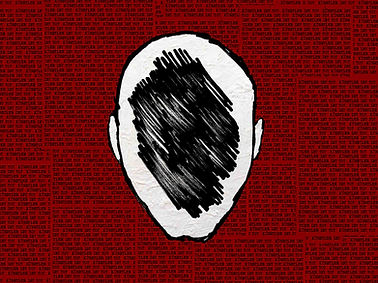
"KÜNSTLER IST TOT"
“God is dead,” wrote Nietzsche. The artist too is dead—or perhaps only erased. Not killed, but absorbed. The myth of the lone genius has dissolved into the noise of mass communication, where every act of creation risks becoming content, and every gesture a performance for the feed.
Here, the face at the center has no features—only the trace of something once expressive. Surrounded by slogans, announcements, propaganda, it stares without seeing. The artist as author, as voice, as authority, is fading. Authenticity has lost ground to repetition, individuality to branding.
And yet, in this void, lies potential. The death of the artist may be the necessary sacrifice for a rebirth—a new art no longer tied to ego, but to presence. Not singular, but collective. Not ornamental, but existential.
Interpretation is not only invited—it is required.
02
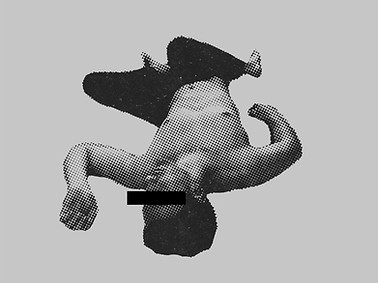
"FALLS 2"
A reinterpretation of the original Falls within the charged aesthetic of PROPAGANDA. The bodies—now the artist’s own—are cast into a space of violent repetition. Their fall is politicized, depersonalized. The slogans linger:
Backward we are cast,
Unaware how much we have left.
Blaze of separation;
Empty bodies, scorched heads.
And just as we once were not,
We are no longer there.
A collective descent, emptied of narrative—yet heavy with consequence.

03
"FREE THE NIPPLES"
A fully veiled female figure raises her fist in a gesture of protest. Her body is covered by a garment that erases form, leaving only the intention of the movement. Behind her, dozens of posters repeat the same slogan: Free the Nipples.
The work places in dialogue two coexisting yet distant realities: on one side, the struggle to reclaim a part of the body often censored; on the other, the silent resistance of those still required to cover themselves entirely—perhaps demanding nothing more than the right to exist in public space. The same word—freedom—takes on radically different shapes and limits.
04
"ALPHA"
A woman stands at a urinal, smoking a cigarette. She balances on tiptoes—reaching for something not designed for her. The gesture is bold, irreverent. Behind her, a wall of pale blue posters lists a series of adjectives: confident, fearless, dominant, assertive. Genderless in form, yet unmistakably coded.
The color evokes boyhood. The words evoke hierarchy. Qualities celebrated, admired, even idealized—but almost always imagined on male terms. ALPHA stages the tension between claims and archetype, between inclusion and imitation. In claiming space, the figure reveals the architecture that denies it—pointing to one of the defining frictions of our time.
